Showing posts with label Animals. Show all posts

Environmental Enrichment Ideas for Your Dog

In my last blog post, I explained what environmental enrichment is and discussed it's importance for your pet's wellbeing. Now I'm going to describe some of the best ways to provide environmental enrichment for your pet, starting with dogs. But first, here's a reminder why it's so important...

Our modern lifestyle places dogs under enormous pressure. With the ever-increasing human population, particularly in major cities, many of us opt for apartment or unit-living as a more convenient and affordable housing option. We then expect our companion dogs to live happily with us in our smaller abodes, content with a daily walk, and to behave appropriately while we're at work all day. This expectation is unrealistic.


Remember that all the dog breeds we have today were originally developed to perform a job: Border Collies and Australian Kelpies herded livestock; Labradors and English Springer Spaniels were used as gun dogs to flush and retrieve game; German Shepherds, although originally used for herding, were and continue to be utilised for police and military work. Many of the smaller breeds, including the Dachshund, Italian Greyhound, Pomeranian and Shih Tzu were used to hunt small animals and as watch dogs. While some dogs are still used for these jobs, the majority now spend their lives as our companions.

The reality is that many dogs are living in environments in which they are unable to exhibit normal behaviour leading to boredom, frustration and behaviour problems such as excessive barking, destructive behaviour and house soiling. In addition, research shows that social and spatial restriction and too little environmental variability can cause dogs chronic stress, fear and frustration which can also lead to the expression of undesired behaviour, particularly separation anxiety (Kiddie et al., 2017).

This is why environmental enrichment is so important for our pet dogs. The goals of enrichment are to increase behavioural choices and facilitate species appropriate behaviours in order to reduce abnormal and problem behaviour; increase positive utilisation of the environment; increase the animal's ability to cope with challenges and, overall; to enhance welfare (Kiddie et al., 2017).

Types of Enrichment

Broadly speaking, environmental enrichment can be divided into Animate (or social) and Inanimate (or physical). Animate enrichment involves interaction with a human or other dog(s) whereas inanimate enrichment involves interaction with inanimate objects such as toys, feeding enrichment, olfactory or auditory stimulation (Kiddie et al., 2017). Dogs need both animate and inanimate enrichment for optimal wellbeing.

Enrichment Ideas for Your Dog

When deciding what kind of environmental enrichment to give your dog, it's important to consider your dog's breed/breed type, their temperament and personality, their age, health as well as their likes and dislikes. Research the behavioural and temperamental traits of your dog's breed/breed type if you are not familiar with them already. Observe your dog's behaviour and take note of the activities they engage in of their own accord. This will provide clues about the types of enrichment your dog might enjoy most. For example, does your dog really enjoy playing and interacting with other dogs or do they generally prefer the company of people? Is your dog head over heels for balls and fetch, tug games or do they prefer to sniff everything?


Here are some of the most popular ways to provide enrichment for your dog:


Social Enrichment

Positive interactions and experiences with a variety of people and other dogs is important throughout every dog's life to maintain their sociability. Including your dog in activities and outings, while ensuring they're having a positive experience, will help develop their confidence and engage their senses. This is particularly important when it comes to your vet and groomer. Ensure your dog has many more positive experiences with the vet/groomer compared to negative experiences to avoid them developing fear/anxiety-based aggression. This can be as simple as taking your dog to the vet/groomer when you don't have an appointment and feeding your dog some yummy treats or having the staff do so.

Dedicated dog parks are a great place to take friendly, sociable dogs who interact well with other dogs. Unfortunately, though, some owners take dogs to these parks that are unsuitable because they're aggressive, anti-social or too boisterous which can cause real problems.


Some dog owners believe their dog should be friendly and sociable with every other dog it encounters and this is an unrealistic expectation. Just like we pick and choose our friends, based on having things in common and getting along well, dogs also have preferences when it comes to other dogs. Rather than expecting and allowing your dog to interact with every dog it meets, which often leads to conflict, allow your dog to play and interact only with other dogs you know they like and get along well with. Regular play dates with the same dogs are a great way to provide your dog with social enrichment in a safe environment.


Feeding Enrichment

No wild-living animal gets their food for free, given in clean bowl. Every. Single. Day. Even though our pet dogs are domesticated and don't need to hunt and scavenge for food, they still retain the instinct to seek and find food. In fact, research shows that animals prefer to work for food rather than get it of free - this phenomenon is called contra freeloading (Iglis et al., 1997).

One of the easiest way to provide enrichment for your dog is to feed them their meals exclusively from a food dispensing toy. Doing so encourages mental problem solving and physical activity as your dog engages with the toy in an attempt to get the food. If you feed dry food, try the Kong Wobbler, a Snuffle Mat or interactive food maze toy. If you feed canned or raw food, try stuffing it into the Green Feeder or the Outward Hound Fun Feeder. Varying your dog's diet, if appropriate, is another great way to provide enrichment.


Puzzle toys, such as those made by Nina Ottosson, can be used to feed your dog their meals or as a challenge to find special treats. These are high quality products that are made to last and are a great investment for dogs that enjoy problem solving. They vary in their degree of difficulty so choose one to suit your dog's skill level. These toys can provide entertainment for a period of time and are wonderful for dogs that spend hours at home while their owners are working.


Play Enrichment

TOYS!!! Most dogs LOVE toys. Toys are a great way to provide appropriate outlets for normal dog behaviours such as chewing, mouthing, biting, licking, chasing and tugging. When these behaviours are directed towards people they're totally inappropriate, but when dogs use toys as outlets for these behaviours, it's completely acceptable.


Think about how your dog engages in play with toys. Are they a toy destroyer, determined to rip apart every toy you give them? If so, look for high quality and durable toys, such as those made by Kong and Aussie Dog Products. These companies make a fantastic variety of toys for dogs that love to chew, tug and chase. It's important to provide these dogs with an appropriate outlet to avoid your clothing, furniture or household items being destroyed.

If your dog loves soft toys, try Hide a Squirrel which combines the fun of squeaky toys and problem solving. Your local op shop is another great place to find cheap soft toys.


Training Enrichment

Teaching your dog new tricks and behaviours provides an excellent form of enrichment. Learning requires problem solving and concentration and when coupled with positive reinforcement training, most dogs relish the opportunity to learn. Try short daily training sessions using high value treats to reward desired behaviour. If you'd like to learn more about how to train your dog effectively using a science-based and human training method, try Clicker Training.

If you have a little more time and motivation, why not consider participating in a dog sport like agility, flyball, herding, lure coursing or nose work? Check out the Pets4Life website for a complete list of dog sports and clubs in Australia.


Outdoor Enrichment

If your dog spends hours home alone, providing a variety of enrichment while you're away is important. Outdoor tug toys such as the Tether Tug or Home Alone by Aussie Dog Products are popular choices. In the warmer months, a clamshell pool/sandpit can provide great entertainment for dogs that like water or for those that like to dig for treats and toys.

Being outdoors away from the home is incredibly enriching for dogs that spend a lot of time indoors or confined to the property. The new smells, sights, people and other dogs all add to the excitement.  Daily walks, outings and even adventures to local beaches or walking trails that allow dogs provide incredibly rich experiences for dogs allowing them to engage all their senses. The Dogs Allowed website is a great resource listing a variety of places, including parks, beaches, cafes and walking trails, in Australia that allow dogs.


There are many more ways to provide your dog with environmental enrichment and we would LOVE to hear what kinds of enrichment you give your dogs. Let us know in the comments section!


References:


Kiddie, J., Bodymore, A., Dittrich, A., & Phillips, C. (2017). Environmental Enrichment in Kennelled Pit Bull Terriers ( Canis lupus familiaris ). Animals: An Open Access Journal from MDPI, 7(4), Animals: an Open Access Journal from MDPI, 2017, Vol.7(4).

Inglis, I. R., Forkman, B., & Lazarus, J. (1997). Free food or earned food? A review and fuzzy logic model of contrafreeloading. Animal Behaviour, 53(6), 1171-1191.

Blogging again: Some news and what's to come...

Hello and welcome!
Welcome to the Pets Behaving Badly blog, version 2.0! So yeah, I've been a bit ok, VERY slack the last few years, blogging-wise, but I'm excited to be back and hopefully posting on a regular (or at least semi-regular) basis.

img

So, what's news?
Let's just say that life got in the way a bit, as it tends to do, but some pretty exciting stuff has been happening. Firstly, I became a mum! Last May my husband and I welcomed our first little human, Nathan, into the world. I can't believe he's nearly 15 months old already. Everyone says the first year flies and it really did. Being a parent has been such an incredible experience and we are beyond excited to be expecting our second little person next month. I'm currently on maternity leave and taking a break from consulting but I anticipate returning to work, on a part-time basis, in March next year. In the mean time I'm looking forward to keeping in touch via Facebook: Pets Behaving Badly with Dr Kate - Animal Behaviourist and this blog.

Me and my little man, Nate
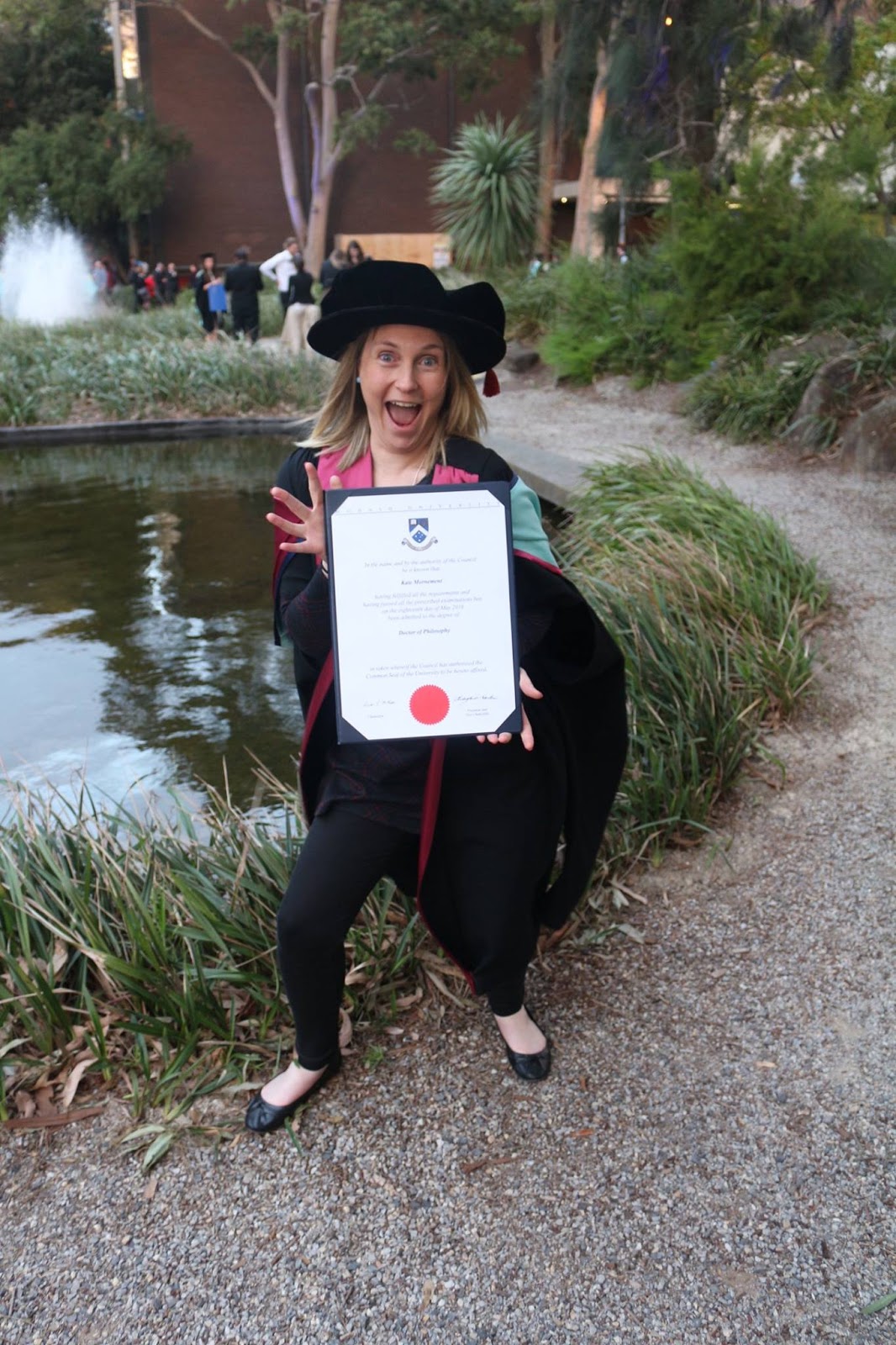
The other exciting news is that I finished my PhD. HOORAY! My research focused on public attitudes towards shelter dogs and the assessment of dog behaviour to determine adoption suitability. It was a long and challenging "journey" but simultaneously lots of fun and incredibly rewarding. I recently wrote a guest post summarising my research and findings for Dr Jo Righetti's blog, if you'd like to know more.

Graduation day. Doing a PhD does make you a little crazy :)
Mostly life has been awesome! Except when we had to say goodbye to our much loved Boxer, Archie, in September last year. Archie was diagnosed with advanced lymphoma and only lived another 6 weeks after his initial diagnosis. He was 9 years old and we miss him terribly. He has left a Boxer-shaped hole in our world and we so look forward to the day we welcome another Boxer into our home. I'm so glad that our little fella Nate met Archie but I'm not sure the feeling was mutual. I'll be writing about introducing babies and existing pets as well as pet loss, including my personal experiences, in future posts.

Archie (9 years) and Nathan (9 weeks)

Other than kids and a PhD, running Pets Behaving Badly has kept me very busy. Most of my work still involves consulting pet owners to help them understand and modify problem behaviour but I also consult to industry and those working with animals in a professional capacity. I continue to write freelance about all things animal behaviour, for magazines like Pets Magazine, and recently wrote a book chapter about companion animals for a tertiary text book about Human-Animal Interactions. In addition to this I work as an expert witness in cases involving menacing or dangerous dogs, present seminars and workshops and occasionally lecture in human-animal relationships at LaTrobe University.

That's nice but why should I follow this blog?
Good question! If you love pets and you're interested to learn more about their behaviour, welfare and management then this is your kind of blog and you should subscribe for regular updates! No pressure :)

Posts will draw on my experiences as an applied animal behaviourist, research scientists and mum to provide readers with helpful and practical tips to understand, manage and resolve common pet behaviour problems and to enhance the owner-pet relationship. I also plan to bring you the latest scientific discoveries relevant to companion animals and the human-animal bond.

Your input and suggestions for blog posts is most welcome. So if you have a question, or a concern regarding your pet's behaviour, let us know via the Facebook page and we'll do our best to write about it in a blog post.

In the mean time, go have fun with your pets!

Dr Kate :)


Professional Animal Training Workshop at the Shedd Aquarium - Part 2

The first two days of the Animal Training Workshop at Shedd Aquarium were absolutely fantastic. Little did I know it was going to get EVEN better! How so? Well, you'll just have to read on!

Day 3:

Wednesday began in the usual way. Most of us arrived just after 8:30am. Coffee, juice, bagels and yummy pastries laid out again as they had been each day - spoilt! The first item on the agenda for the day was an exam to assess our knowledge of what we had learned over the past two days. Piece of cake!

The lectures on day three covered 'One on One vs Group Training' and included 'stationing strategies' (where you teach an animal to go to a particular location) and 'new animal introductions' and 'Providing Your Animal with Variety' (in training sessions, habitat selection, play sessions, social structure and toys). We then moved onto 'Advanced Techniques and Concepts' in training which require experience to apply. This topic covered 'defining your criteria', 'secondary reinforcers', 'schedules of reinforcement' and 'punishment, negative reinforcers and aversive stimuli'.

We observed training sessions with a Barred Owl, Great Horned Owl and a Harris Hawk. These sessions concentrated on desensitising the birds to a large crowd of people (us!), teaching them to accept tactile from their trainer, stationing and target training.

At 6pm we had a lovely social dinner at Shedd but immediately prior to that was the most incredible surprise. At about 5pm we were taken to the room where staff prepare guests for animal encounter experiences. It was at this point we were told that we were all going to have a once a lifetime Beluga whale encounter. After being fitted with some super stylish brown waders we headed for the Beluga habitat. In my group was Sharon (a horse trainer), Mariela (a dog trainer), Allison (a zookeeper), Erin (who wants to be a marine mammal trainer) and myself. Our group was very fortunate to be led by Ken Ramirez himself who introduced us to Kayavak, a 13 year old female Beluga. Ken has known and trained her since she was born at Shedd. Ken and Kayavak have the most amazingly close relationship, unlike anything I've seen between a trainer and non-domestic animal. She followed him everywhere and relished the chance to have Ken tickle her tongue - hilarious!

Me hand targeting Kavayak, the Beluga whale

We each got to cue several behaviours with Kayavak including targeting, spy-hopping, spitting water, vocalising and various other husbandry behaviours. This was an experience we will never forget!

Day 4:

Thursday began with lectures and we continued on with 'Advanced Training Concepts'. Topics covered were 'conditioned punishers', 'recall training' and 'chained behaviour'. We then moved onto 'Aggression' and 'Solving Problem Behaviour'. Ken spoke about aggression being a normal behaviour and that almost all animals have some degree of aggression in their behavioural repertoire. We tend to forget (or fail to acknowledge) this when it comes to our companion animals. Ken spoke of the importance of 'identifying the problem', 'planning', 'determining the cause' of problem behaviour and 'considering the balance of reinforcers vs punishers (motivation)' and that once a behaviour modification plan had been implemented that 'behaviour analysis and constant monitoring' is critical to evaluate its effectiveness.

Animal training sessions included sessions with Tyler and Tanner (Californian Sea Lions) in which Ken continued to work on the training goals he had set at the start of the week: A voluntary blood draw (for Tyler) and Free Contact with Tanner. We also saw a training session with two Sea Otters. The trainers worked on a range of behaviours including targeting (multiple targets and body parts), stationing, accepting being caught in a net, porpoise (kind of like a duck dive), retrieve objects, go inside a crate etc.

After another jam packed day of learning, networking and observing training sessions I went to dinner with a friend I met at the workshop.

Day 5:

As I walked to Shedd in the sunshine on the final day of the workshop I was sad that it was coming to an end. The people and animals I'd met, friends I'd made, conversations I'd had and knowledge gained made for a memorable and extremely enjoyable week in Chicago.

Friday began with our final exam which tested our knowledge of topics covered on the previous two days. After that, we met two very cool animals; a Black and White Tegu called Uncle Fester and an Aracari called Beau.

Target training "Uncle Fester" the Black and White Tegu
Training "Beau", the gorgeous Aracari, to station on the hand

During the lunch break we got to see the Aquatic Show which starred the Pacific White-sided dolphins, Beluga whales, Tyler the California sea lion and Ken Ramirez! It was a great opportunity to see how the training we had observed throughout the week is applied in shows to demonstrate species specific behaviour, animal intelligence, communicate critical conservation messages and the special relationships the trainers have with the animals to the general public.

After lunch we broke into groups to play some trainer games. Each group was provided with a bag containing about 20 small objects (e.g. toy cars, dominoes, dice, toy animals etc). We played three different versions of the game in which one person was the trainer and another person was the animal. The trainer used a clicker to mark a desired behaviour and verbal praise to reinforce it. The first game involved teaching the animal to perform three different behaviours (e.g. move toy car along table surface) and then put each behaviour on a different cue. The second game also required the trainer to teach the animal three behaviours on cue and in addition, to chain the behaviours together and introduce a new cue for the three chained behaviours. Talk about a challenge! These games were lots of fun and an invaluable way to gain insight into the way another animal learns. The games also helped us improve our timing of marking and reinforcing desired behaviour.

In the afternoon we made our way to the last training sessions with Tyler and Tanner. Watching Ken train Tyler throughout the week was certainly one of my highlights. They share such a unique and close relationship. Tyler's personality and behaviour really reminds me of a giant playful dog.

Just as we lined up to observe Tyler's last session Ken told us another amazing surprise. Each of us was given the opportunity to be "kissed" on the cheek by Tyler. Of course, every single one of us jumped at the opportunity! While this may seem like an enormous task for Tyler, he easily accomplished it. Ken kept up a very high rate of reinforcement and took breaks in between kisses to work on other behaviours that Tyler enjoyed. As you can tell from the photo below I thoroughly enjoyed my sloppy, smelly and very fishy kiss!

A kiss from the gorgeous Tyler, a California sea lion

I couldn't resist a photo opportunity with Ken on the last day! He's such a rock star of the animal training world :)

Me with Ken Ramirez

The very last animal training session we observed for the workshop was the Beluga whales. We made our way to the beluga habitat and watched five trainers work six animals. Here's a video highlighting some of that training...


The workshop concluded with a farewell dinner in the President's room overlooking Lake Michigan and the Chicago skyline. Ken sat at our table and entertained us with some incredible stories of animals he had worked with and their amazing intelligence and personalities.

In the President's room for the farewell dinner
At the closing dinner overlooking Lake Michigan and the Chicago skyline

My week at Shedd Aquarium was one I will never forget. I met some amazing people and animals and learned from one of the world's most well respected animal trainers. I cannot say enough about how amazing Ken Ramirez is - a gifted teacher, animal trainer and storyteller. If you're an animal behaviour and training geek (like me) and you're lucky enough to have the opportunity to learn from him then take it! You won't regret it.

The knowledge and experiences I bring home from the Animal Training Workshop will further improve the services I provide my clients as an animal behaviourist and consultant. As it turns out, the timing of this workshop could not have been better. I have been hired by Melbourne Aquarium to deliver several staff training workshops on animal behaviour, learning and training later this year. I look forward to assisting their staff to better understand the behaviour of the animals in their care and how to interact with them to promote optimal behaviour outcomes.

Keep an eye out for a future blog post about the Melbourne Aquarium workshops!

This is not a travel blog but let me tell you a little bit about Chicago...

At the end of my last post I mentioned I was currently in Chicago in the USA. While this is not a travel blog I do want to share my experiences in this amazing city so far and the reason I came here in the first place...

I arrived in Chicago on Thursday night last week after a 30+ hour journey from my home in Melbourne, Australia. The reason I'm here is to participate in an animal training workshop, run by world-renowned animal trainer Ken Ramirez, at the Shedd Aquarium. The 5 day workshop starts tomorrow (Monday) and around 30 people, mainly from the USA but also other parts of the globe, are attending.
Here's a brochure about the workshop
For last three days I've been getting to know the city of Chicago and I must admit, I'm a bit in love! The architecture (especially the Gothic!), the weather (warm with sunny blue skies), the skyline, the sights, the people and even the coffee (well, in one shop at least) have really left an impression.

REAL coffee in the USA!!!
I'm blown away by how friendly people are. People actually say "hello" and "good morning" to you here! This morning when I left the hotel to walk to my favourite coffee shop; Intelligentsia (where they make REAL coffee!), I counted about five "hellos" and "good mornings" from complete strangers. As a tourist I really feel at home here.

Taken just outside my hotel looking down S. Michigan Avenue
I've spent hours walking around downtown Chicago admiring the buildings and taking in all the sights and sounds. The city is really clean, full of cultural diversity and literally crawling with people! This weekend the Chicago Air and Water Show is on. Lake Michigan is teaming with and boats and yachts of all shapes and sizes and jet planes scream as they buzz the Chicago skyline, including my hotel!

Yesterday I did a 'Hop On, Hop Off' bus tour - a fantastic way to see the sights. I learnt of the Great Chicago Fire of 1871 which destroyed almost the entire city which, at the time, was constructed mainly of timber. Chicago was completely rebuilt and is nicknamed "The Second City". We drove down the Magnificent Mile where, we were told by our guide, most of the shops are lucky to break even due to exorbitant rent. Other landmarks we saw were Navy Pier, the Museum Campus, Millennium Park and the Chicago Theatre.

Chicago Theatre
Today I walked to the Museum campus, where Shedd Aquarium and the Field Museum are located. I spent a couple of hours exploring the museum and learned all about Sue, the largest and best preserved fossil specimen of a Tyrannosaurus Rex ever found. Sue was named after Sue Hendrickson, the Palaeontologist who discovered the 90% complete skeleton.

"Sue" the T-Rex fossil at the Field Museum in Chicago
Well that's a taste of my time in Chicago so far. Over the next few days I'll post about what I learn and who I meet at the workshop at Shedd Aquarium. Stay tuned!


A brief history on how I became an Animal Behaviourist...

Welcome! This is a blog about animal behaviour and training as well as my work as an animal behaviourist.

I have been meaning to start a blog for years now and was recently inspired to bite the bullet by my lovely friend Mia Cobb, who has just started a fabulous blog, about all things canine science, called Do You Believe in Dog? You should follow her blog too if you love (or believe in) dogs!

So here we go. I guess I'll start with a brief history of how I became an animal behaviourist...

After finishing school back in 1996 I had no idea what I wanted to be. So, I did what most kids in such a predicament do, I enrolled in an Arts degree! In my first year of Arts at La Trobe Uni I studied Archaeology, Sociology and History. For a brief while I thought I might like to be a Palaeontologist and spend my life digging in the dirt for dinosaurs. After all, Jurassic Park was one of my favourite movies. Fortunately I realised my real passion was studying living animals when I transferred to an Arts/Science double degree in my second year. I soon discovered I LOVED science! Well, more specifically, I loved Zoology. Learning all about the ecology, behaviour and physiology of different taxa was fascinating! I loved zoology so much that I worked really hard and received high enough marks in my third year to get into the zoology honours program (4th year).

In 2003 I completed my honours year and was fortunate enough to work with a world renowned ornithologist called Dr Richard Zann, investigating sexual attractiveness and mate choice in zebra finches. My honours year was incredible. I loved the whole experience; the friends I made, the independent research and the supervisor-student relationship were just brilliant. During honours I was responsible for the daily husbandry of Dr Zann's zebra finch colony on campus. Every day I would feed, water and clean (even on weekends!). It was hard work but it paid off. I was awarded first class honours!

Male (left) and female (right) zebra finches

In 2009 Richard was tragically killed in the Victorian bush fires, along with his wife and daughter. I still miss Richard to this day. He was an amazing supervisor and a mentor. Generous with his time and genuinely interested in my career after honours, we would catch up every year when I came to lecture his third year students about dog behaviour and my work as an animal behaviourist. I miss him very much and I'm so grateful I had the privilege of knowing, and learning from, him.

After honours, in 2004, I travelled to Thailand and Borneo where I volunteered with SOSRhino in the jungles of the Tabin Wildlife Reserve. You can read about that adventure here.

Me with France and JJ chasing Rhinos in the Tabin Wildlife Reserve, Borneo, Malaysia

Upon returning from my travels I worked briefly in a large pet shop which opened my eyes to the welfare issues associated with selling animals in pet shops. I saw a lot of things that turned my stomach, the details of which I won't go into here, hence I lasted less than 6 months! During my time in the pet shop customers constantly asked me about pet behaviour problems..."my puppy keeps weeing on my rug", "my bird won't stop screaming", "how do I stop my cat scratching the couch?" I happened to know a bit about behaviour and was able to provide some advice. I realised that many people needed help to understand their pets behaviour and how to resolve common behaviour problems and so Pets Behaving Badly was born! Follow me on Facebook on the Pets Behaving Badly Facebook page!

I left the pet shop and concentrated on the business and gaining more knowledge and experience in the field of animal behaviour. I decided I would go back to university to do a PhD so I set about finding a supervisor whose research area was human-animal interactions (also called Anthrozoology). When I met Associate Professor Pauleen Bennett for the first time to discuss the possibility of her supervising me, we immediately hit it off. At the time she was based at Monash University (now at La Trobe University in Bendigo) and she offered me a casual Research Assistant job in the Anthrozoology Research Group helping her with various research projects her group was conducting.

In 2006 I enrolled to do a PhD in canine behaviour, researching the assessment of shelter dog behaviour for adoption suitability. Six years later and I'm still plugging away. One of the reasons it's taking me so long is that Pets Behaving Badly is now a huge success!

In my first year as an animal behaviour consultant I had less than 10 behaviour consultations. All I had was a basic website and some business cards. I couldn't afford marketing or advertising, so business was slow. Fast forward to this year and I'll crack well over 100 behaviour consultations! In addition to providing in-home consultations I run seminars and workshops for pet owners and people who work professionally in the animal industry and I provide an expert witness service in legal cases where a dog's behaviour has been called into question. I also work as a freelance writer and regularly write articles for Pets Magazine, Pet Pages, Pooch Magazine, Dogs NSW and the Herald Sun. To see more of my media work, including an interview on A Current Affair, click here.

My job is really fun and diverse. Not only do I get to meet and work with amazing people who love animals, I get to do other fun stuff like radio interviews and even a stint on the TV as behaviourist/presenter on the wonderful show all about dogs: Hound TV. Here's the first episode I appeared in...


My job also allows me to travel interstate and overseas for conferences and workshops, as part of my ongoing education in the field. Recently I went to Orlando, Florida to do the Contemporary Animal Training & Management workshop at Natural Encounters Inc.

Recall training with a Green Wing Macaw, Natural Encounters Inc., Orlando, USA

Whilst in Florida I had to visit the theme parks. At Sea World I was lucky enough to have the opportunity to train the Beluga whales. Funniest thing, they feel like hard boiled eggs!

Training a Beluga whale at Sea World, Orlando, USA

Right this minute I'm sitting in my hotel room in Chicago in the USA. Why am I here? Well, it's animal related and a whole other story. So, stay tuned for the next instalment to find out...

Well, that's how I became an animal behaviourist (in a nutshell). Ok, so that wasn't exactly "a brief history". I promise I will try to keep my posts short and sweet from here on in. Thanks for stopping by and (hopefully) reading the first instalment of my blog. I hope you enjoyed it :)